




Dell Latitude E6400 XFR
Especificaciones de Portátil(es)
Price comparison
Promedio de 3 puntuaciones (de 5 análisis)
Análisis para el Dell Latitude E6400 XFR
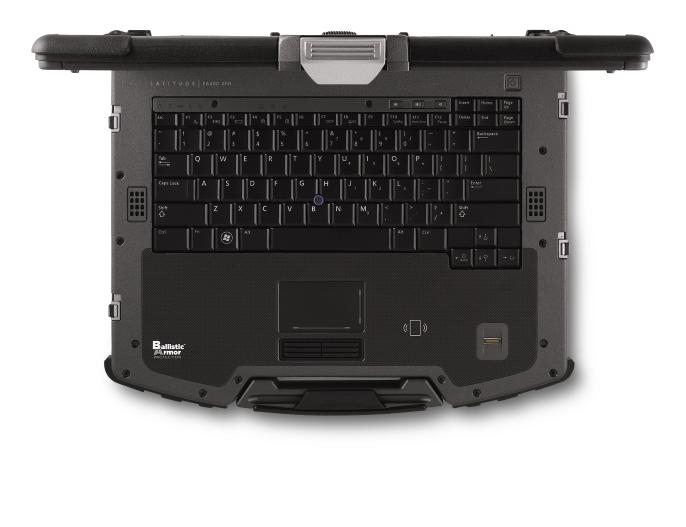
A prueba de balas El Dell Latitude E6400 es la versión extra robusta del portatil de negocios E6400 y competencia directa del Panasonic Toughbook CF-19. El XFR suma puntos con la compatbilidad del E6400 y la estable construcción. Como este "portatil de campo" se mostró en las pruebas se muestra en el siguiente artículo.
Origen: Techradar
 EN→ES Archive.org version
Great protection, staggering performance and decent usability. Dell is one of the world's best known laptop manufacturers and makes a broad range of machines for both business and consumer markets. It's impossible not to be impressed by the E6400 XFR, however, and if you want to give your data the best chance of survival in extreme conditions, few laptops are better.
Único Análisis, disponible online, corto, Fecha: 02/18/2010
Puntuación: Puntuación total: 80%
Origen: Trusted Reviews
EN→ES Archive.org versionOverall, the E6400 XFR is a deliberately different proposition to competing rugged laptops. It's not best suited to situations where you really need to keep the weight down and it doesn't have the battery life or mission critical ruggedness for the most demanding environments, but it is very powerful, making it a useful alternative for anyone that doesn't want to sacrifice on performance
Único Análisis, disponible online, largo, Fecha: 11/03/2009
Puntuación: Puntuación total: 70% precio: 60% rendimiento: 90% características: 80% movilidad: 60%
Origen: Laptop Mag
EN→ES Archive.org versionThis fully rugged notebook combines top-notch performance with impressive durability. Those in the market for a fully rugged notebook need something that can hold up to the elements, but it also needs to perform well as a notebook when Mother Nature isn’t abusing it. Dell’s Latitude E6400 XFR combines an already strong business laptop with one of the toughest exteriors we’ve seen. At $5,137, it’s about a grand more than the GD Itronix GD8000, but users can expect significantly better performance—albeit at the expense of battery life. Overall, the E6400 XFR is a very strong rugged notebook, especially for customers who want to purchase all their laptops from a single vendor.
Único Análisis, disponible online, largo, Fecha: 09/15/2009
Puntuación: Puntuación total: 80%
Origen: Notebookreview.com
EN→ES Archive.org versionThe Dell Latitude E6400 XFR is a well built, higher performing, fully rugged notebook. It is based off of the Latitude E6400, with a ruggedized chassis wrapped around it. While it is definitely more rugged than the standard E6400 or E6400 ATG, it may not be as durable as other fully rugged notebooks. Dell chose to use plastic cladding for most of the external panels while other manufacturers use stronger metal panels. The main area of concern with this approach is the cooling fan grill, which showed significant flex, and may be an area that could get damaged in a tumble. The performance of the E6400 XFR is well above other rugged notebooks, but this comes at the cost of battery life
Preis 40, Leistung 90, Display 80, Verarbeitung 50
Único Análisis, disponible online, largo, Fecha: 07/03/2009
Puntuación: precio: 40% rendimiento: 90% pantalla: 80% procesamiento: 50%
Origen: Notebookcheck
 DE→ES Archive.org version
Único Análisis, disponible online, largo, Fecha: 07/31/2009
Puntuación: precio: 40% rendimiento: 60% características: 40%
Comentario
NVIDIA Quadro NVS 160M: Basada en la GeForce 9300M GS pero optimizada para uso estable de negocios (controladores y bios especiales). Soporta PureVideo HD para ayudar a la CPU a decodificar videos HD. Velocidad de memoria: 400 MHz GDDR2, GDDR3 a 700MHz.
Estos procesadores gráficos pueden mostrar únicamente juegos antiguos, fluidamente. Juegos actuales pueden ser presentados con detalles sustancialmente reducidos.
>> Más información puede ser encontrada en nuestra comparación de tarjetas gráficas moviles y la lista de benchmarks.
Intel Core 2 Duo: Este es el sucesor Core Duo y el Core Solo con un pipeline más largo y con una velocidad entre 5-20% sin mayor consumo de energía. Adicional al diseño de Core Duo existe un cuarto decodificador, una unidad SSE ampliada y una unidad lógica aritmética (ALU) adicional.
Sus características son: 2 núcleos (cores), una amplificación de comando de 64-bit EM64T y 2 o 4 MB L2 Cache y 291 millones de transistores, que son acabados en 65nm. Mas allá de esto, todos los tipos soportan técnicas "Execute Disable Bit", SSSE3 (SSE4), Enhanced Speedstep, LaGrande y la mayoría de técnicas de virtualizacion (VT) Vanderpool.
El Core 2 Duo para laptops es idéntico a los procesadores Core 2 Duo para desktops, pero los procesadores para notebooks trabajan con tensiones más bajas (0.95 a 1188 Volt) y un Frontside bus clock (1066 contra 667 MHz). El rendimiento de laptops cuena con una frecuencia de 20-25% más baja que PCs Desktop debido a una frecuencia más baja de Frontside bus y los discos duros más lentos.
P9600: La P9600 es una CPU de doble nucleo de gama media de la linea Core 2 Duo y es similar al T9550 (excepto por el menor TDP de 25 vs. 35vatios). El rendimiento del P9600 debería ser suficiente para la mayoría aplicaciones y juegos de 2009.
>> Más información puede ser encontrada en nuestra comparación de procesadores móviles.
 Add as a preferred source on Google


