




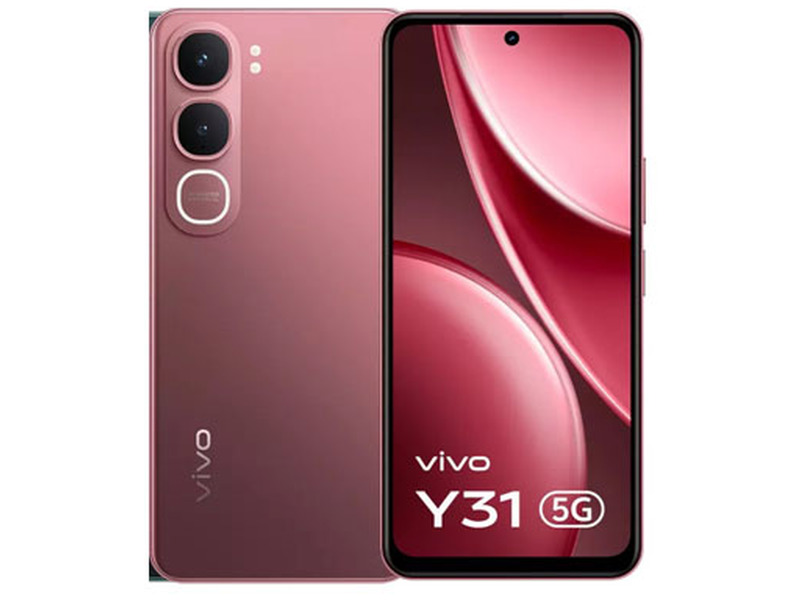
Vivo Y31 5G (2025)
Especificaciones de Portátil(es)
Cámara secundaria: 8 MPix
Price comparison
Análisis para el Vivo Y31 5G (2025)
Origen: OI Spice Tech News
 EN→ES
EN→ESThe vivo Y31 (2025), announced and released on September 15, enters the budget 5G segment with a rugged design and a focus on long-lasting battery life. It carries IP68/IP69 ratings and MIL-STD-810H compliance, which is rare at this price. The phone feels large and slightly heavy at 209 g, but the build quality is solid, and the Guardian Glass protection adds extra confidence. On the front, it uses a 6.68-inch IPS LCD with a smooth 120Hz refresh rate. The screen reaches 1000 nits in HBM, but the 720p resolution and 264 ppi density keep it on the softer side. Still, for everyday use and media, the display looks decent and bright enough outdoors. Powering the phone is the Snapdragon 4 Gen 2 chipset built on a 4 nm process, paired with Adreno 613 GPU.
Único Análisis, disponible online, Muy corto, Fecha: 12/12/2025
Comentario
Qualcomm Adreno 613: Chip gráfico para smartphones y tabletas, integrado en el SoC Qualcomm Snapdragon 4 Gen 2. Aunque es el sucesor del Adreno 619 del SD 4 Gen 1, su rendimiento es significativamente inferior en la clase básica.
Estos procesadores gráficos pueden mostrar únicamente juegos antiguos, fluidamente. Juegos actuales pueden ser presentados con detalles sustancialmente reducidos.
>> Más información puede ser encontrada en nuestra comparación de tarjetas gráficas moviles y la lista de benchmarks.
SD 4 Gen 2: SoC de nivel básico con 8 núcleos Kryo (dos núcleos basados en ARM Cortex-A78 con hasta 2,2 GHz y 6 ARM Cortex-A55 con hasta 2 GHz) y un módem X61 5G. Fabricado en 4nm en Samsung.
>> Más información puede ser encontrada en nuestra comparación de procesadores móviles.
Portátiles similares de otros fabricantes y con otro CPU
Portátiles con el Mismo Tamaño de Pantalla y Peso
 Add as a preferred source on Google


